
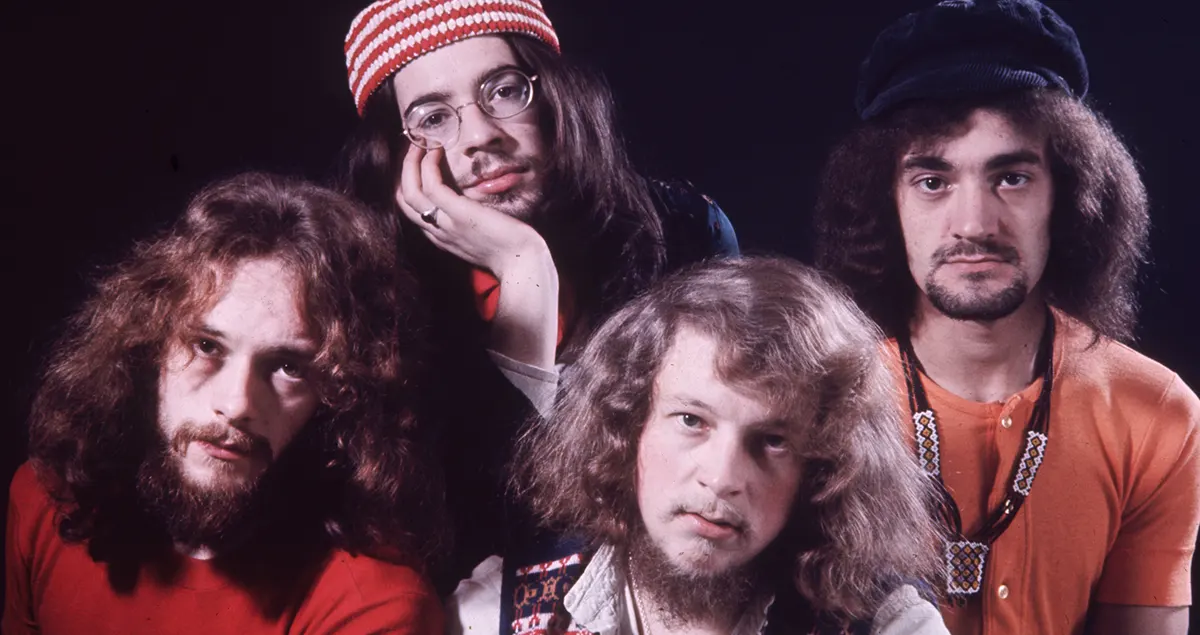
Jethro Tull: Folk, Irony, and the Uncomfortable Intelligence of Progressive Rock
Progressive rock is often associated with grandeur, virtuosity, and scale, but Jethro Tull followed a different path. Rather than pursuing excess, they embraced character, irony, and contradiction. Their music draws from folk traditions, blues roots, and hard rock energy, weaving them into a progressive framework that feels both cerebral and grounded.
Jethro Tull did not treat progressive rock as a vehicle for transcendence or spectacle. They treated it as a space for argument, satire, and uneasy intelligence.
Prog Rock History — Where Jethro Tull Stands
Jethro Tull emerged at a time when progressive rock was defining itself through complexity and ambition. While many contemporaries leaned toward classical influence or extended abstraction, Jethro Tull turned inward toward tradition. Folk melodies, acoustic textures, and narrative songwriting became their primary tools.
Historically, Jethro Tull occupy a unique position in prog: they bridge the genre’s experimental impulses with older musical forms. This connection to tradition allowed them to challenge progressive rock from within, often questioning its seriousness through humor and irony.
They proved that progressive thinking did not require maximalism — only intention.
Creative Phases and Lineup Evolution
Blues Roots and Early Identity (1968–1969)
Jethro Tull began as a blues-oriented band, but even their earliest recordings hinted at restlessness. Ian Anderson’s flute quickly became a defining element, setting the band apart from rock conventions. The instrument functioned less as ornamentation and more as a disruptive voice within the ensemble.
Folk-Progressive Synthesis (1970–1972)
With albums like Benefit and Aqualung, Jethro Tull refined their identity. Folk elements became structural rather than decorative, and lyrical themes grew sharper and more confrontational. This period established the band’s reputation for blending accessibility with complexity.
Conceptual Ambition and Satire (1972–1975)
Thick as a Brick represents one of progressive rock’s most unusual statements. Framed as a parody of the concept album, it nonetheless delivers a single extended composition of remarkable coherence. The album simultaneously participates in and critiques progressive rock’s ambitions.
Subsequent releases continued this duality, balancing narrative structure with skepticism toward excess.
Refinement and Adaptation (Late 1970s)
Later albums reduced conceptual scale while retaining compositional sophistication. Acoustic textures, melodic clarity, and restrained arrangements defined this phase, demonstrating Jethro Tull’s ability to evolve without abandoning identity.
Albums by Function, Not Ranking
The Cultural Breakthrough: Aqualung (1971)
Aqualung introduced Jethro Tull to a broader audience while preserving lyrical complexity. Its exploration of religion, morality, and social alienation remains one of the band’s most enduring achievements.
The Conceptual Provocation: Thick as a Brick (1972)
This album functions as both a satire and a masterclass in long-form composition. It challenges the seriousness of progressive rock while proving that discipline and humor can coexist.
The Folk-Progressive Statement: Songs from the Wood (1977)
Here, Jethro Tull fully embrace folk tradition as a progressive tool. The album prioritizes atmosphere and melody, offering a more intimate interpretation of progressive ideas.
The Transitional Work: Benefit (1970)
Often overlooked, this album marks the moment when the band’s progressive tendencies crystallized. Its balance of acoustic and electric textures laid the groundwork for future experimentation.
Themes, Irony, and Lyrical Voice
Ian Anderson’s lyrics are central to Jethro Tull’s identity. They favor irony, skepticism, and narrative voice over abstraction or transcendence. Characters are flawed, institutions are questioned, and certainty is rare.
This lyrical approach grounds the band’s music, preventing progressive ambition from drifting into detachment. Humor becomes a tool of critique rather than escape.
Where to Start Listening — Entry Points by Listener Type
- Classic rock listeners: Aqualung
- Concept album enthusiasts: Thick as a Brick
- Folk-oriented listeners: Songs from the Wood
- Early prog explorers: Benefit
- Skeptical newcomers: Minstrel in the Gallery
Each album offers a different balance between accessibility and experimentation.
Why Jethro Tull Can Be Challenging
Jethro Tull’s irony can be misread as detachment. Their frequent shifts between acoustic and electric textures may feel inconsistent to listeners expecting a singular sonic identity. Lyrical density and narrative ambiguity also demand attention.
Yet these challenges reflect the band’s refusal to simplify. Jethro Tull reward listeners willing to engage with contradiction rather than resolution.
Influence and Legacy
Jethro Tull influenced progressive rock by expanding its expressive vocabulary. Their integration of folk traditions opened pathways for future bands to explore cultural roots without abandoning complexity. More importantly, they demonstrated that progressive rock could critique itself without collapsing.
Their legacy lies not in scale, but in perspective.
What Prog Rock Would Lose Without Jethro Tull
Without Jethro Tull, progressive rock would lose its sharpest sense of irony. The genre might still achieve structural brilliance and emotional depth, but it would lack a voice willing to question its own assumptions.
Jethro Tull ensured that progressive rock could remain intelligent without becoming self-serious — a balance few bands have managed.