
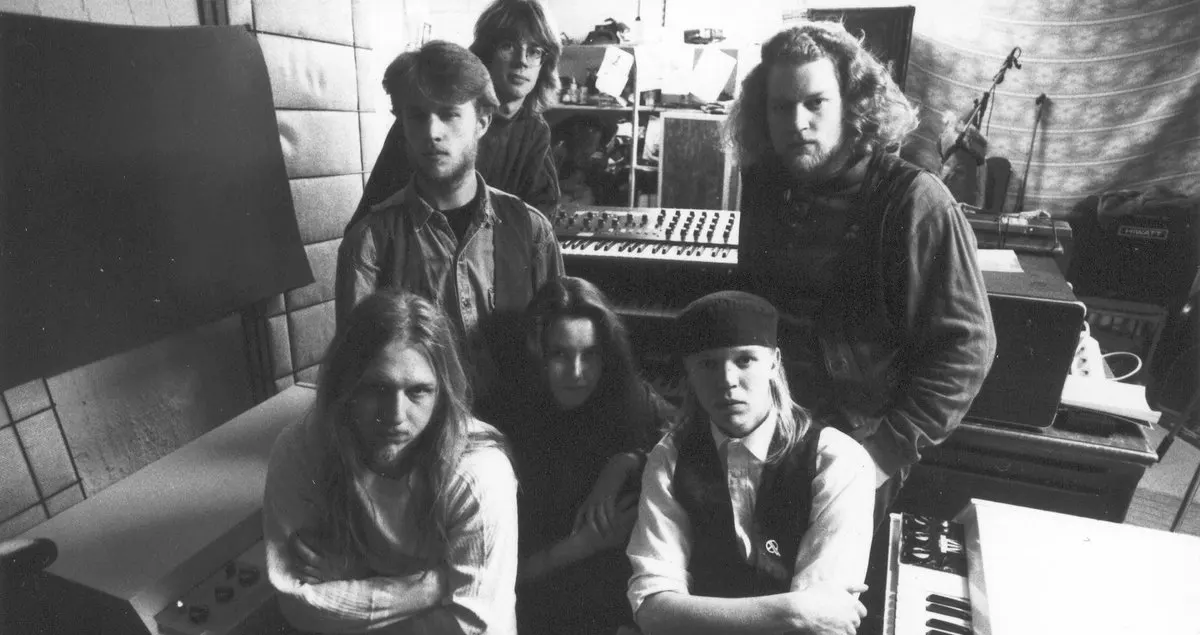
Änglagård: Nordic Darkness, Discipline, and the Revival of Progressive Rock
By the early 1990s, progressive rock was widely regarded as a historical style — admired, archived, but largely concluded. Änglagård challenged that assumption. Rather than modernizing prog through technology or accessibility, they revived its spirit of discipline, atmosphere, and restraint, proving that progressive rock could return without nostalgia.
Änglagård did not update progressive rock.
They reawakened it.
Prog Rock History — Where Änglagård Stand
Änglagård emerged in Sweden during a period when progressive rock survived mainly through retrospection or fusion with metal and pop. Instead of following either path, they looked backward with intentional rigor. Drawing from early King Crimson, Scandinavian folk melancholy, and symphonic structure, they reconstructed progressive rock as a living language.
Historically, Änglagård represent the moment when progressive rock re-entered cultural relevance as a serious artistic form, not through reinvention, but through fidelity to core principles: atmosphere, long-form structure, and emotional gravity.
They occupy a unique position as the bridge between classic prog and modern progressive revival.
Creative Phases and Singular Identity
Formation and Deliberate Isolation (1991–1992)
Änglagård formed with a clear rejection of contemporary trends. Their sound emphasized Mellotron weight, dynamic contrast, and compositional patience. From the outset, the band prioritized ensemble cohesion over individual virtuosity.
Their early work established a tone of isolation and introspection, shaped by Nordic landscape and cultural restraint.
The Foundational Statement (1992)
With their debut, Änglagård delivered a fully realized progressive statement that felt both ancient and immediate. Rather than experimenting publicly, they presented a sound already complete and uncompromising.
This approach distinguished them sharply from revivalist acts that leaned on homage without depth.
Silence, Absence, and Return (Mid–Late 1990s)
After initial success, Änglagård retreated into near silence. This absence reinforced their mystique and underscored their resistance to commodification. When they later returned, it was with continuity rather than reinvention, deepening rather than revising their aesthetic.
Albums by Function, Not Ranking
The Revival Manifesto: Hybris (1992)
This album functions as Änglagård’s declaration. Dense Mellotron passages, shifting dynamics, and somber atmosphere establish a progressive language rooted in restraint and tension. Hybris proved that classic progressive principles could feel urgent without modern embellishment.
The Structural Refinement: Epilog (1994)
More austere and introspective than its predecessor, Epilog sharpens focus. The album emphasizes silence, pacing, and emotional weight, offering a colder but more disciplined expression of the band’s identity.
The Continuity Statement: Viljans Öga (2012)
Released after a long hiatus, this album confirms Änglagård’s consistency. Rather than updating their sound, the band reaffirm their commitment to atmosphere and structure, demonstrating that progressive rock can age without dilution.
Musical Language and Nordic Atmosphere
Änglagård’s music is defined by gravity. Melodies unfold slowly, harmonies linger, and rhythmic shifts occur with deliberate control. Mellotron textures provide orchestral mass, while acoustic passages introduce fragility and contrast.
Vocals are sparse and restrained, often functioning as another textural layer rather than a narrative voice. Lyrics, when present, reinforce the music’s introspective tone without demanding interpretation.
The result is music that feels geographical — shaped by environment as much as composition.
Where to Start Listening — Entry Points by Listener Type
- Classic prog revival seekers: Hybris
- Atmosphere-focused listeners: Epilog
- Modern prog traditionalists: Viljans Öga
- Mellotron enthusiasts: Hybris
- Patient listeners: Epilog
Each entry point reflects a different degree of intensity within a consistent aesthetic.
Why Änglagård Can Be Challenging
Änglagård demand patience. Their music avoids hooks, minimizes vocals, and resists emotional release. The absence of overt drama or virtuoso display can feel austere to listeners expecting momentum.
Yet this restraint defines their value. Änglagård reward sustained attention, revealing depth through accumulation rather than immediacy.
Influence and Legacy
Änglagård catalyzed the modern progressive rock revival. Their success demonstrated that authenticity and discipline could resonate in a post-progressive era. Numerous Scandinavian and European bands drew inspiration from their approach, prioritizing atmosphere and structure over novelty.
They re-established progressive rock as a serious compositional practice, not merely a historical reference.
What Progressive Rock Would Lose Without Änglagård
Without Änglagård, progressive rock’s revival would lack credibility. The genre might still exist as homage or hybrid, but it would miss proof that classic principles could sustain new artistic relevance.
Änglagård showed that progress does not always move forward.
Sometimes, it returns with purpose.